Contact Me

Contact Me
Contact Me

Working Mom Blogger

Working Mom Blogger
Working Mom Blogger

Health & Wellness

Health & Wellness
Health & Wellness


Showing posts with label WHO. Show all posts

WHO Well-Being Challenge - Stress Less, Eat Better, Move More

 
The WHO Well-Being Challenge aims to help us increase our well-being in three specific areas to support us in improving our general health and well-being. The three areas are:
 
1. Stress less, where we learn simple stress management techniques.
 
2. Eat Better, where we can improve our health and well-being by making small changes to our eating habits.
 
3. Move more, where we improve our physical health by simply walking.
 

#1: Stress Less - Doing What Matters in Times of Stress

 
 Stress is a natural human response that makes us react to challenges and threats in our lives. It basically means feeling troubled or threatened. Everyone experiences stress to some degree at times. A little stress can be good and it's generally not a problem. However, too much stress can cause issues to physical and mental health. It's the way we respond to stress that makes a big difference to our overall well-being.
 
According to WHO, there are 5 skills which are easy to learn and can be used for just a few minutes each day to help us reduce stress.
 

Grounding, Unhooking, Acting on Values, Being Kind, Making Room

 
 I won't go into details but I'll highlight the key points. If you want to read the full details, do visit http://bit.ly/WHOStressManagement
 
Here's an example that WHO used to describe how to apply the 5 skills.
 
First, notice how you're feeling and what you're thinking. Then, you breathe into the difficult thoughts and feelings, and let the breath flow into and around them. This is the grounding step.
 
If you're feeling pain or having difficult thoughts (this means you're hooked), notice it with curiosity. Notice its shape, size, and temperature, and silently name it - "I notice here's a difficult thought". Your pain might get bigger or smaller; it might stay or it might go. Then, you refocus on what you're doing at the time the difficult feelings emerge. This is the unhooking step.
 
There are three approaches when it comes to dealing with difficult situations. Number one, leave. Number two, change what can be changed, accept the pain that cannot be changed, and live by your values. Number three, give up and move away from your values. This is the acting on values step.
 
Even in the most difficult situations, there are ways we can act on our values of kindness and caring. Even tiny little actions of kindness can make a difference. This includes kind words. Not just for others, but for ourselves, too! Try speaking to yourself kindly. When you're kind to yourself, you'll have energy to be kind to others too. This is the being kind step.
 
Finally, the aim of all the steps above is to simply make room, to allow the difficult situation to be there, to stop fighting it, and to give it space.

The key is to practice until we're familiar about dealing with stressful situations in our life.
 

#2: Eat Better - Good Nutrition Reduces the Likelihood of Developing Health Problems

 
The four important principles for eating better are as follows.
 

Eating a mix of foods for a healthy you

 
To stay healthy, it's important to eat different types of food every day. Include different kinds of foods like a variety of fruits and vegetables, whole grains (unprocessed maize, millet, oats, wheat and brown rice), legumes (lentils, beans and peas), and animal products (lean meat, fish, eggs, and low-fat and unsweetened dairy products) in your diet every day.
 

Keep an eye on your salt intake

 
Don't eat more than 5 grams a day, which is equal to just one teaspoon. Cut back on salty sauces and condiments. Watch out for canned and dried foods, they are usually very high in sodium. Eat fewer processed foods. Always read the labels on food products to be aware of the amount of hidden sodium.
 

Limit fats, oils and sugar

 
Swap butter, ghee, and lard with healthier oils like olive, soybean, sunflower, or corn oil.  Go for chicken or fish instead of fatty red meat. Choose low-fat or reduced-fat milk and dairy products. Don't eat too much processed meat. Stay away from foods that have bad fats (trans fats) - these are often found in fried and baked goods. Try cooking your food by steaming or boiling instead of frying. Cut back on sweets and sugary drinks. Pick fresh fruits instead of sugary snacks like cookies and cakes.
 

More water, less alcohol

 
Choose water when you can instead of those sugary drinks. Water is safe and doesn't cost much. Drinking alcohol can lead to injuries, liver damage, cancer, heart issues, and even mental health problems. There's actually no safe amount of alcohol. So, it's best to avoid it altogether for a healthier lifestyle. In summary, prioritize hydration with water and abstain from alcohol for better overall health.


#3: Move More - Regular Physical Activity is Good for Our Heart, Body and Mind


Make physical activity a priority, as it benefits our heart, body and mind, prevents and manages diseases such as cardiovascular diseases, cancer and diabetes, and reduces symptoms of depression and anxiety.
 

Starting with walking 10 minutes a day

 
WHO recommends walking 10 minutes a day for people who are just getting started in their physical activity routine. Once you're more comfortable with walking daily, it is recommended to do 30 minutes of exercise every day.
 
Set aside just 10 minutes each day. Walking - at any pace - is incredibly good for you! When you start to walk, pick a speed you can manage. Walking, no matter how fast, is good for you. Choose a pace that feels comfortable. Make being active a priority to feel healthier and happier. Think about tomorrow and find a good time for a short walk. Every minute you walk is a step toward feeling even better! Find what works best for you! Remember to write down how many minutes you walk each day.

0

Staying Safe and Stress-Free During the Holiday Season

 
Following are health and wellness tips by World Health Organization (WHO).

Stay Safe Over the Holiday Season

 
For many people, this time of year means increased travel and contact with loved ones. Remember to do your best to keep yourself and others safe from COVID-19, flu and the common cold.
 
It's still important to wash your hands frequently, keep at least 1-meter distance from others whenever possible in public areas, and wear a mask.

Look After Your Mental and Physical Health

 
Feelings of anxiety from life's challenges are common. How you cope affects well-being. If you feel low, here are some things you can do to help:
 
🗣️Talk to someone you trust about how you feel.
🏃🏼‍♀️Try to keep up with activities you usually enjoy.
😁Stay connected with friends and family.
😴Stick to regular eating and sleeping habits.
👩🏼‍⚕️Seek professional help if you're able to.
 

Simple Ways to Reduce Holiday Season Stress

 
⏰Stick to a daily routine.
🥰Connect with loved ones and other people.
🥗Eat healthy food and balanced meals.
🧘🏻‍♀️Exercise regularly.
😇Be kind to yourself.
📱Limit stress-inducing news consumption.
🤗Do activities that make you happy.
😴Prioritize sleep.
 

Sleep Better to Reduce Stress


Getting enough sleep is important for both body and mind. Sleep repairs, relaxes and rejuvenates our body and can help reverse the effect of stress.
 
Here are 5 tips to help you get a good night's sleep:
 
🕥Go to bed and wake up at the same time each day, even on weekends.
⚫Make your sleeping area quiet, dark, relaxing and a comfortable temperature.
📱Limit your screen time before bed.
☕Avoid large meals, caffeine and alcohol before bed.
🏃🏼‍♀️Get exercise during the day.


Boost Mental Health with Exercise

 
Regular activity prevents high blood pressure and weight gain, enhancing well-being. WHO recommends 30 mins daily for adults, 1 hour for children. Stay active by:
 
🤸🏻‍♀️Online exercises
💃🏻Dance to music
🎮Play active video games
💪🏻Skip rope
🦵🏻Climb stairs
 
Stretch if you work from home:
🧍🏻‍♀️Check posture
🧍🏻‍♀️Stand up 
 

Prioritize Nutrition for Mental Well-Being


A healthy diet helps protect against malnutrition, non-communicable diseases, and boosts mental health. Per day, a healthy diet includes:
 
🥗Fruit, vegetables, legumes, nuts and whole grains.
🧈Less than 30% of energy intake from fats.
🧂Less than 5 grams of salt.
🍬Less than 10% of energy intake from sugar.

Eating at least 5 portions of fruits and vegetables helps prevent the risk of disease and gives you important vitamins, minerals, and fibre. You can improve your intake by:
 
🥦Including veggies in your meals.
🍊Choosing fruits and raw veggies for snacks.
🥭Opting for produce that is in-season.
🍅Varying your choices to get a range of nutrients.


May we all have a merrier, calmer holiday season!


0

#SunProtectionSeries: A Guide to Safeguarding Against Harmful UV Rays


Why is sun protection so important?

 
Sun protection is a crucial aspect of maintaining healthy skin and reducing the risk of sun damage, premature aging, and skin cancer.
 
The sun's ultraviolet (UV) rays can cause immediate damage to the skin, such as sunburn, tanning, and sunspots. Prolonged and repeated exposure to UV rays over time can lead to more severe consequences, including premature aging (wrinkles, sagging skin) and an increased risk of skin cancer, including melanoma, the most dangerous form of skin cancer.
 

What are UV rays?

 
 The sun emits ultraviolet (UV) radiation, a type of energy which cannot be detected by our senses, unlike the sun's light or heat. Therefore, we will not notice the damage until it's been done.
 
UV radiation consists of UVA and UVB rays. Both UVA and UVB rays are harmful to the skin.
 
  • UVA rays penetrate deeply into the dermis layer of your skin, causing wrinkles and age spots, making your skin looks older than it is, causing long-term damage and premature aging.
  • UVB rays primarily affect the surface of your skin and cause sunburn.
  • Both types of UV rays contribute to the development of skin cancer.


What is UV Index?

 
The UV Index (UVI) is a measure of the intensity of UV radiation on the Earth's surface that is relevant to effects on the human skin.

The Global Solar UV Index measures UV levels on a scale from 0 (Low) to 11+ (Extreme). Sun protection is recommended when UV levels are 3 (Moderate) or higher.


📲 Recommendation from WHO📲

 
Download the free SunSmart Global UV app to get advice and five-day forecasts on UV index and sun protection necessity.


What is SPF?

 
SPF or Sun Protection Factor is a measure of a sunscreen's ability to protect the skin from UVB rays. It indicates how long you can stay in the sun without getting sunburn compared to not using sunscreen.
 
For example, if you use SPF 30, you can stay in the sun 30 times longer without burning than if you were unprotected.
 
SPF 15: Prevents 93% of UVB rays from being absorbed by the skin.
SPF 30: Prevents 97% of UVB rays from being absorbed by the skin.
SPF 50: Prevents 98% of UVB rays from being absorbed by the skin.
 
However, bear in mind that SPF does not indicate the level of UVA protection. Therefore, it is recommended to opt for "broad-spectrum" sunscreens that offer protection against both UVA and UVB rays.
 

How to protect your skin from harmful UV rays?


🧴Apply sunscreen🧴

 
Apply sunscreen often, generously, and evenly to all exposed areas of the skin. The American Academy of Dermatology recommends using about one ounce (approximately a shot glass) of sunscreen to cover the entire body. Apply it at least 15-30 minutes before sun exposure to allow it to bind to the skin properly. Reapply every two hours or more frequently if swimming, sweating heavily, or toweling off.
 
Look for sunscreens with active ingredients such as zinc oxide and titanium dioxide (physical blockers) that reflect and scatter UV radiation. These ingredients are less likely to cause skin irritation or allergic reactions compared to some chemical sunscreen ingredients. However, many sunscreens now use chemical filters that absorb UV rays. Find a sunscreen that suits your skin type and preferences.


🌴Seek shade🌴

 
Stay in shade whenever possible. When the sun is strongest, typically between 10 a.m. and 4 p.m., seek shade to reduce your exposure to harmful UV rays. If shade is limited or unavailable, consider using an umbrella or wearing protective clothing.
 

😎 Cover up with clothing, sunglasses, and a hat 😎

 
Wearing sun-protective clothing, sunglasses, and a hat when you are under the sun is an effective way to shield your skin from the sun's harmful rays.
 
Look for garments with a tight weave, dark colors, and a UPF (Ultraviolet Protection Factor) label, which indicates the amount of UV radiation the fabric blocks. A higher UPF rating means greater protection. Wide-brimmed hats, sunglasses, and UV-blocking umbrellas also provide additional protection.
 

☀️ Adopt sun-protective behaviors ☀️

 
Along with sunscreen and protective clothing, adopting sun-safe behaviors is essential. Avoid tanning beds and sunlamps, as they emit harmful UV radiation that can damage the skin. Regularly perform skin self-examinations to detect any new or changing moles, spots, or growths. Consult a dermatologist if you notice anything suspicious.
 
 
Remember, sun protection is necessary year-round, regardless of the weather or the season. Even on cloudy or cooler days, UV rays can still penetrate the clouds and cause damage to the skin.
 
By adopting sun-safe habits and regularly using sun protection measures, we can help safeguard your skin from the harmful effects of the sun.


0

Mission 6: Living with the virus


 How has COVID-19 changed your daily life?


COVID-19 has completely changed our lives and adapting to the norms has been challenging for most of us. We are all adjusting to new ways of living and working and it is important for us to do this so that we can stay healthy, while enjoying life and getting back to school or work.


And now, it's time to live with the virus with this mission statement that I want to live by:


I commit to taking action and changing my behaviors by constant monitoring and reminding myself and my children about practicing the six protective measures continuously.


At the end of the day, living with the virus is all being accountable to ourselves, our family, and others around us. Are we doing the right things when no one else is watching?


Assessing risks before attending any events / get-togethers, restricting time spent in crowded places, only going out when necessary, and continuous practice of the six protective measures are all in our control.


Certificate of participation


Related posts:


Be A Champion Against COVID-19

Mission 1: Share the Facts & Stop Misinformation About COVID-19

 Mission 2: Promoting a healthy lifestyle

Mission 3: Personal responsibility & self-monitoring

Mission 4: Staying mentally healthy during COVID-19

Mission 5: Supporting COVID-19 vaccination


0

Mission 5: Supporting COVID-19 vaccination


Are you vaccinated against COVID-19?


My kids and I are vaccinated against COVID-19. I'm well aware of the pros and cons of vaccination and I'm making informed decisions to go ahead with the COVID-19 vaccination.


Keeping the conversation positive


I commit to supporting COVID-19 vaccination by keeping the conversation positive and avoid being argumentative about my decision to get myself and my kids vaccinated against COVID-19.


Ultimately, it's your choice to be vaccinated. As I mentioned earlier, I understand both the pros and cons. In the end, it's my choice to believe that the pros outweigh the risks. And for those who believe the opposite of this, I have no hard feelings against them.


While vaccines are an important tool for fighting COVID-19, vaccines alone do not end the pandemic. Luckily, the main tools to fight COVID-19 are available to everyone, which includes leading a healthy lifestyle, continuing to practice the protective behaviors, and motivating others to do the same.


Six protective behaviors


There are six protective behaviors that everyone can follow to help slow the transmission of COVID-19.


  1. Clean hands regularly
  2. Prevent droplets from spreading
  3. Keep at least 1 meter apart
  4. Limit time spent in enclosed or crowded places
  5. Clean frequently touched objects and surfaces
  6. Respond appropriately if experiencing COVID-like symptoms


Related posts:


Be A Champion Against COVID-19
Mission 1: Sharing the facts & stop misinformation about COVID-19
Mission 2: Promoting a healthy lifestyle
Mission 3: Personal responsibility & self-monitoring
Mission 4: Staying mentally healthy during COVID-19

Mission 6: Living with the virus


0

Mission 4: Staying mentally healthy during COVID-19


Recognizing the signs of stress


Did you find the past two years to be challenging and stressful? Have you been experiencing any of these feelings, thoughts or behaviors lately such as feeling troubled or threatened, struggling to focus, crying often, getting angry easily, having difficulty sleeping or feeling sad, guilty, worried, or very tired?


In times of uncertainty when things are so hard during the pandemic, stress is one sign that your mental health might be suffering.


Maintaining a healthy mind and building resilience


Mission 4 is about staying mentally healthy during COVID-19 by maintaining a healthy mind and building resilience. This week I commit to staying mentally healthy during COVID-19 and support the well-being of people around me by taking regular breaks for myself to recharge mentally and reset my mood so that I can have the necessary emotional quota to listen to people around me.


What can we do to maintain a healthy and resilient mind?


Here are some of the many documented ways to stay mentally healthy:

  • Limit the time you spend reading stressful news and read and share good stories instead.
  • Talk to someone you trust.
  • Stay connected to your friends and family, especially those who may be far away or living alone.
  • Watch a movie or read books, exercise, make crafts or catch up on things you haven't had the time for.
  • People with preexisting conditions should keep taking any medication you are on, keep in contact with your health care worker, and draw on the skills you have used in the past to manage your feelings and cope.
  • Practice grounding exercise to reduce stress, improve your well-being, and cope with difficult thoughts and feelings.
  • Get help from a professional if you start feeling very overwhelmed or are not able to function as normal. Reach out to your family doctor, local healthcare services or a social worker. Talk to your family, friends or another trusted person in your community if you need help finding a service. If you can't see someone in person, there may be telephone based or remote options available.


Why is taking breaks important?


For me, I'm a big fan of taking regular breaks when things seem to have become overwhelming.


According to The Wellbeing Thesis, micro-breaks, lunchtime breaks and longer breaks, have all been shown to have a positive relationship with well-being and productivity. Studies have found that breaks can reduce or prevent stress, help to maintain performance throughout the day, and reduce the need for a long recovery at the end of the day.


Social breaks or interactions, such as chatting with your peers allow you to share your experiences and feel part of a group during mini-breaks.


I have kind of mastered the art of taking breaks at work and off work because I'm an easily stressed-out person. First, I have identified my trigger points, for example traffic jams. So I will tune in to either BFM or Spotify without fail during my daily commute to work. By doing so, I'm taking a break from the stress of driving.


I will also be taking walking breaks for 5-6 minutes every 2-3 hours when I'm at work. At 4:30pm or so, I will take a fruit break or tea break. True enough, I don't break down at work because by taking these breaks that I deserve, I'm maintaining a healthy, resilient mind that keeps me productive for a longer time.


By doing so, I then can have the necessary emotional quota to listen to people around me, be it my family, friends, or colleagues. Read more about this on my previous blog post, Returning to Normalcy.


If there's any consolation, the new relaxed SOPs effective 1 May 2022 should be happy news for everyone!


Related posts:


Be A Champion Against COVID-19
Mission 1: Sharing the facts & stop misinformation about COVID-19
Mission 2: Promoting a healthy lifestyle
Mission 3: Personal responsibility & self-monitoring

Mission 5: Supporting COVID-19 vaccination

Mission 6: Living with the virus


0

Mission 3: Personal responsibility & self-monitoring


 COVID-19 has impacted each and every one of us differently. Some of us have fallen sick with COVID-19 infection and recovered. Some may still be battling with long COVID. Some, unfortunately, have succumbed to the sickness.


It's up to us to minimize our chance of exposure to the virus by understanding the risks and practicing protective behaviors – from where we work or go to school, to how we socialize, what we do in our spare time, and more.


Protecting ourselves and others from COVID-19


Mission 3 is about protecting ourselves and others from COVID-19. This week, I commit to reducing the risks of contracting COVID-19 by planning my time well so that my family could spend less time in confined, crowded, and closed places this festive season when we are out and about.


Take action to reduce exposure to COVID-19


First, we take action to understand the risks we face based on the different situations and settings we find ourselves in and limit our chances of getting COVID-19.


Now we all know that COVID-19 SOP relaxations are starting on 1 May in Malaysia. However, it's still prudent to practice protective behaviors such as:


  • Regularly washing hands, especially after being in contact with high-touch surfaces and public spaces
  • Bringing along a hand sanitizer
  • Wearing a mask
  • Ensuring good ventilation and fresh air
  • Maintaining physical distancing of at least 1m from others within close conversation
  • Avoiding confined, crowded and close places
  • If going out to eat, we can choose to sit outdoors instead of dining in.
  • Going for a walk when hanging out rather than sitting in a coffee shop or other public spaces


Bottom line is: Know your risk, lower your risk.


Protect people in our community who are particularly at risk of COVID-19


We could also think about different ways we can do to protect ourselves and keep others in our community safe, especially those who are at higher risk of contracting COVID-19.


Groups at high risk of getting COVID-19 include older people / senior citizens and people living in long-term care facilities, as well as people living with underlying health conditions.


There are also many other groups who are susceptible to the virus because of where they live or work or their access to healthcare, who can also use our support:


  • People who are homeless
  • People living in crowded housing or slums
  • Migrant workers
  • People who are displaced
  • People with disabilities
  • People in the correctional institutions
  • People living in remote locations
  • People living in poverty
  • Indigenous populations


My family, including my two kids under 12 are fully vaccinated, i.e., the adults are vaccinated and boosted, and the kids have completed their 2 doses.


Monitor ourselves of symptoms


Finally, monitor our health if we have been in contact with someone who is positive for COVID-19 or are experiencing symptoms. The best way to do this is to apply TRIIS.


  • T - Test with a self-test kit as soon as possible if you are experiencing any infection symptoms such as a runny nose, fever, cough, and others.
  • R - Report the test results on your MySejahtera right away.
  • I - Isolate yourself or quarantine immediately if you have been tested positive for COVID-19.
  • I - Inform your close contacts if your test result is positive. Inform the health authorities or any Covid-19 Assessment Centre (CAC) nearby if your condition has worsened while self-isolating at home.
  • S - Seek treatment at your closest healthcare facility or at a CAC nearby.


Remember - even tiny actions can make a big difference.

Related posts:


Be A Champion Against COVID-19
Mission 1: Sharing the facts & stop misinformation about COVID-19
Mission 2: Promoting a healthy lifestyle

Mission 4: Staying mentally healthy during COVID-19

 Mission 5: Supporting COVID-19 vaccination

Mission 6: Living with the virus


0

Mission 2: Promoting a healthy lifestyle


Prevention is better than cure


You have heard this many times, prevention is better than cure. When it comes to prevention, we will have to talk about living a healthy lifestyle to protect ourselves and people around us from COVID-19.


Truth to be told, the pandemic has altered many of our daily routines and contributed to unhealthier lifestyles among a significant proportion of the population due to physical inactivity, unhealthy eating, and sleeping disturbances.


According to Info Sihat, during the COVID-19 pandemic in 2020 and 2021, several critical public health measures were adopted, including lockdowns and limitations of access to public spaces for physical activities. Unfortunately, these measures - although necessary - have had a negative impact on physical activity levels and sedentary behavior, when they were already insufficient among Malaysians.


Thought process behind promoting a healthy lifestyle


Personally, I believe that instead of the advice-giving kind of communication style, a more people-centered, conversational style of communication will elicit better responses because it provokes the thought process behind why one needs to live a healthy lifestyle.


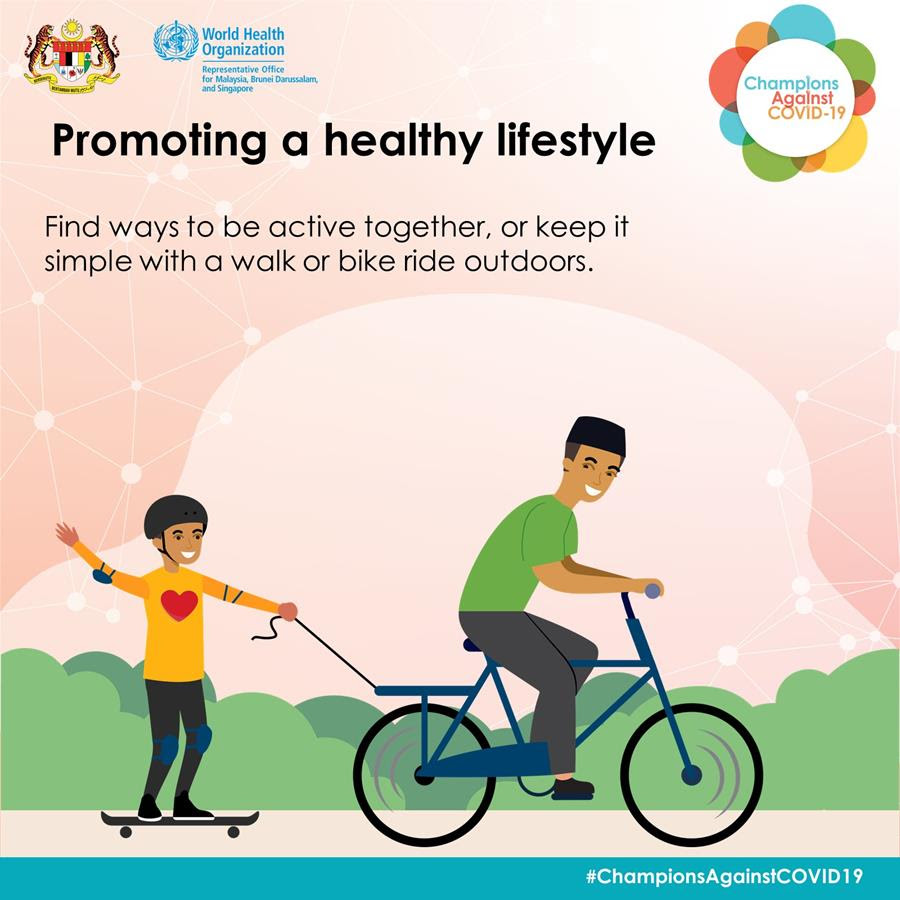
Hence, for Mission 2, I commit to promoting healthy behaviors in my community by initiating conversations regarding the domain of fitness, i.e., physical activity, healthy eating, and emotional well-being.


Fitness domain #1: Why is regular physical activity important?


Regular physical activity is crucial for people of all ages. It can reduce high blood pressure, help manage weight, and reduce the risk of heart disease, stroke, type 2 diabetes, and various cancers - all conditions that can increase susceptibility to COVID-19.


Regular physical activity can help give our days a routine and can be a way to stay in contact with family and friends. It's also good for our mental health - reducing the risk of depression, cognitive decline, and delaying the onset of dementia, and improving overall well-being.


However, telling people about the importance of engaging in 30-60 minutes of uninterrupted physical activity every day may not result in long-term health behavior change. This actually happened to me. In fact, I disliked being told that I need to exercise or else I will become fat.


Instead, why don't we initiate conversations with people in a way that probes them to think about what they could do for just 5-10 minutes per day to improve their physical activity?


For example, I have been leading a sedentary lifestyle due to the pandemic. What I'm doing now to increase physical activity is that I will park my car at the far end of the office block to increase my daily steps count. I will also take walking breaks once every 2-3 hours. I keep track of my steps count with my smartwatch.


The idea behind getting people to think about what they are willing to do to increase physical activity is to build confidence and capacity, while avoiding injury or a sense of failure or resentment. Thus, a long-term behavior change can be achieved.


Fitness domain #2: What is healthy eating?


Healthy eating is more than just understanding what to eat and what not to eat or what is healthy food and what isn't.


It's also crucial to look into the thought processes associated with eating habits, how to respond to hunger cues properly, etc. Many people have a negative perception about dieting. Hence, a non-diet approach can produce a more long-term eating behavior change while not relying on rigid diet rules or strict weight-reduction diets that seldom work in the long run.


Fitness #3: How is emotional well-being playing a part towards a healthy lifestyle?


It's true that physical activity and healthy eating are often tied to a person's emotional well-being. Many have experienced feelings of anxiety, stress, and unhappiness due to the restrictive pandemic situations.


Even something as sidelined as lack of sleep or perhaps even the loss of positive self-image, self-esteem, and confidence could potentially lead to a less than ideal emotional well-being, which in turn will lead to even lesser physical activity and healthy eating. It's like the chicken-and-egg situation.


Hence, instead of pointing out what the person should or should not be doing, it's best to practice kindness and mindfulness while sharing strategies for coping, such as how to express feelings in a safe environment, talking to someone you can trust, using relaxation methods, and taking time for self-care.


I'm a big fan of incorporating small and incremental changes rather than an "all-or-nothing" approach in terms of promoting a healthy lifestyle.


By setting smaller goals such as walking more steps per day, eating more servings of fruits and vegetables, taking time to do things that I enjoy, I find that I'm a much happier person.


Related posts:


Be A Champion Against COVID-19

Mission 1: Sharing the facts & stop misinformation about COVID-19

Mission 3: Personal responsibility & self-monitoring

Mission 4: Staying mentally healthy during COVID-19

Mission 5: Supporting COVID-19 vaccination

Mission 6: Living with the virus


0

Mission 1: Share the Facts & Stop Misinformation About COVID-19


COVID-19 Infodemic


According to WHO, infodemic means a flood of information on the COVID-19 pandemic. Thanks, and no thanks to technology, social media, and messaging apps, they have created a space for an overabundance of both information and misinformation about COVID-19, the virus, and vaccination.


While technology keeps us connected and updated throughout the COVID-19 pandemic, they have also become an avenue to spread rumors and misinformation. Rumors and misinformation can be dangerous to our health. They can stop us from taking the right action to protect ourselves, lead to harmful practices or make us feel stressed because we don't know what to believe.


So, are we doing enough to address the infodemic that happens in tandem with the COVID-19 pandemic/endemic?


Our mission: Share the facts, stop misinformation!


Informed individuals like you and I have the power to reject misinformation and only share information that is factual and helpful. Here's what we can do before we share or forward information about COVID-19.


Look for facts and evidence


Be critical of the information you receive. Does it seem accurate and draw on scientific research and guidelines? Have you compared the information with trusted sources such as WHO, CDC, and KKM?


Some may comment that these trusted sources are not trustworthy or they are saying things for the benefit of the vaccine companies, etc. If that's your opinion, I won't argue with you because to each its own. However, you need to take accountability for what you believe in. Misinformation may cost someone their life.


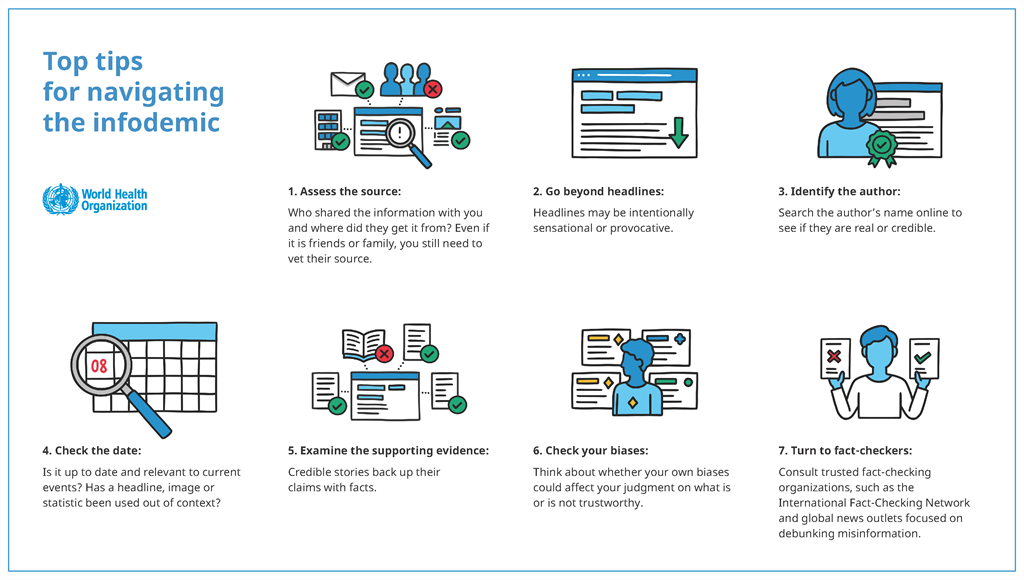
Navigating the infodemic: top tips to identify misinformation or disinformation


Choose carefully


Only share, like or forward content from trusted sources as mentioned earlier on. For me, I will always go back to what WHO, CDC, and KKM say. By doing so, I know I will be sharing facts and not rumors and hear-says or conspiracy theories that cause more panic.


Everyone can help to stop the spread. If you see content online that you believe to be false or misleading, you can report it to the hosting social media platform.


Be cautious


Be careful with what you share. Things aren't always what they seem online. Refrain from sharing information if you are unsure how true or untrue it is. Digital footprint can be impossible to erase. Once you share something that becomes viral, people may screenshot it and spread it around. So, if it turns out to be untrue, can you imagine the repercussions? Call me a coward but I don't want to have someone's blood on my hands.


Be a good example


Respectfully correct or talk to people in your social networks who spread rumors or misinformation. For this, I pledge to commit to spreading facts about COVID-19 to keep society happy this week by only quoting information from WHO, KKM, CDC for anything related to COVID-19 on my social media posts.


Related posts:


Be A Champion Against COVID-19

Mission 2: Promoting a healthy lifestyle

Mission 3: Personal responsibility & self-monitoring

 Mission 4: Staying mentally healthy during COVID-19

Mission 5: Supporting COVID-19 vaccination

Mission 6: Living with the virus


0